
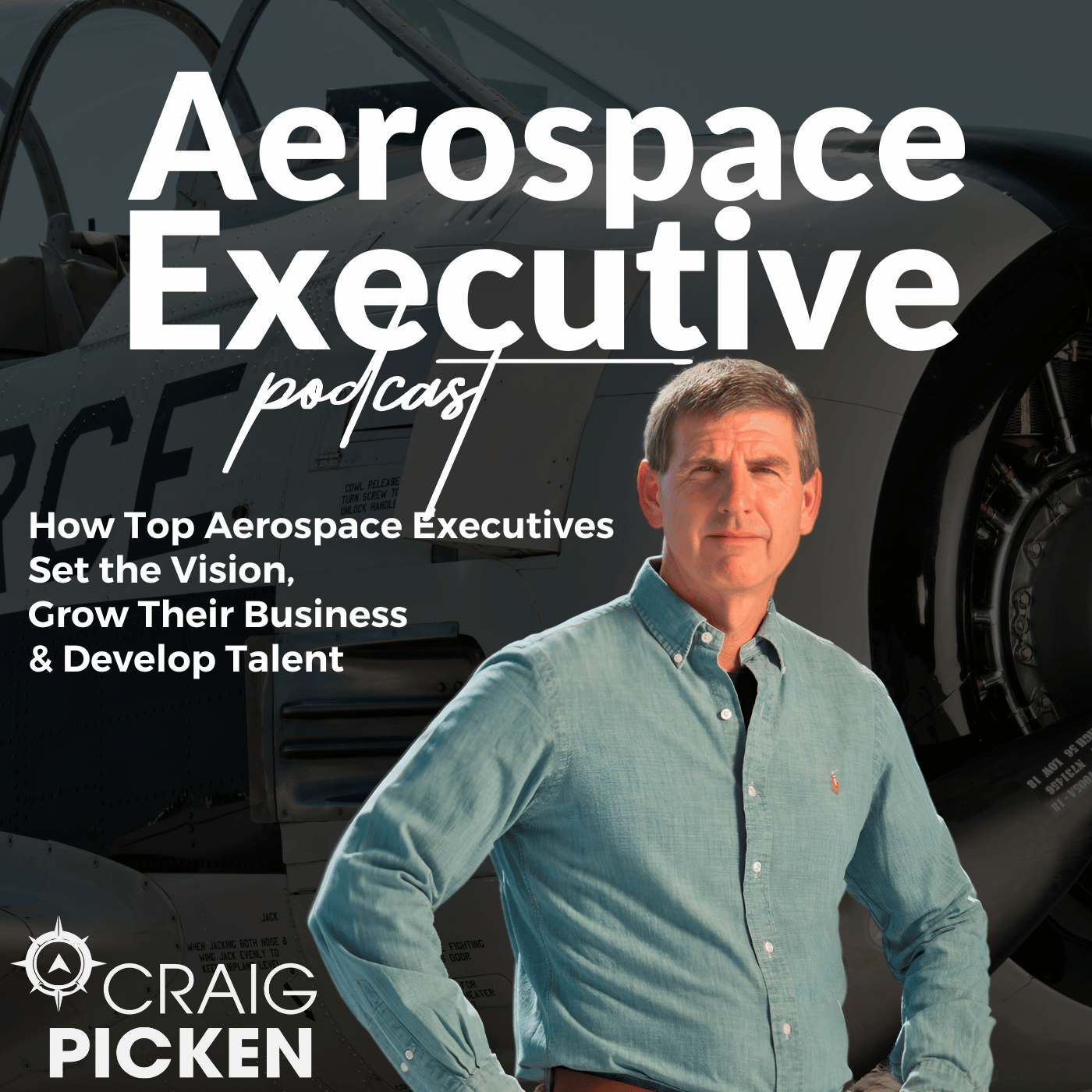
How Top Aerospace Executives Set the Vision, Grow Their Business & Develop Talent
Episodes
Apr 23, 2026
Apr 23, 2026
41 min
Most operators think insurance is about protection. Buy a policy, transfer the risk, move on. But what if that model is quietly draining your margins instead of protecting them?
Because here’s the reality: in aviation, it’s not the catastrophic losses that kill your business; it’s everything else.
The unexpected maintenance event that isn’t covered. The operational hiccups you don’t want to claim. The hangar rash that never makes it to a claim, and you just absorb it.
The constant, low-level financial hits that feel too small to insure but too frequent to ignore. Over time, it’s death by a thousand cuts, and traditional insurance was never built to solve that.
What’s starting to emerge instead is a different mindset: stop thinking of insurance purely as a cost center, and start treating it as a financial strategy. Not to replace the traditional market, but to take back control of everything it leaves behind.
Because when you structure it right, the same dollars you’re used to losing can actually compound back into your business, building reserves, improving margins, and turning risk management into a profit lever instead of a drain.
That’s exactly what captive insurance allows operators to do: take control of the risks traditional aviation insurance won’t cover and structure them in a way that actually works for the business.
John C. Averill and Andy Shuttleworth are two experts working at the intersection of aviation risk and captive insurance.
In this episode, we talk about how operators can formalize self-insurance, why most people misunderstand what captives actually are, and how some businesses are quietly using them to retain profits, smooth volatility, and build long-term financial resilience.
You’ll also learn;
- Why the real financial pressure in aviation doesn’t come from where most operators think
- What actually sits outside traditional aviation insurance and why it matters more than it seems
- The shift from transferring risk to structuring it
- How some operators are starting to take control of costs they’ve always absorbed
- Why certain risks never make it into a policy and what can be done about them
- The difference between reacting to losses and designing for them
- Why the most sophisticated companies approach insurance very differently
- What changes when risk starts to show up on your balance sheet instead of someone else’s
- How to think about control, claims, and costs in a completely different way
- Why this isn’t a short-term fix, and what happens if you commit to it
- Where this approach extends beyond aviation into broader operational risk
- The biggest misconception about captives and why most people misunderstand them
About the Guests
John C. Averill is a Senior Vice President and risk advisor specializing in aviation, aerospace, and defense. His work sits at the intersection of operational risk, insurance, and legal frameworks, allowing him to design highly tailored solutions for complex exposures that traditional brokerage models often miss. With additional expertise in professional liability and environmental underwriting, John brings a broader, more integrated lens to risk, helping operators structure programs that go beyond standard coverage. He is part of a senior-level team with over 100 years of combined experience in insurance and risk management, including more than 50 years focused specifically on aerospace. Connect with John on LinkedIn.
Andy Shuttleworth is a Risk Management and Regulatory Compliance Consultant and the founder of Core Resilience LLC. With over 35 years of experience across federal and state agencies, he brings a deeply practical understanding of how risk, compliance, and operations intersect. Andy works with businesses to assess and strengthen their regulatory compliance, threat mitigation, and risk management strategies, offering an independent, unbiased perspective on where systems break down and how to improve them. His focus is on helping organizations protect not just their assets, but their long-term operational resilience and reputation. Connect with Andy on LinkedIn.
About Your Host
Craig Picken is an Executive Recruiter, writer, speaker, and ICF Trained Executive Coach. He is focused on recruiting senior-level leadership, sales, and operations executives in the aviation and aerospace industry. His clients include premier OEMs, aircraft operators, leasing/financial organizations, and Maintenance/Repair/Overhaul (MRO) providers, and since 2008, he has personally concluded more than 400 executive-level searches in a variety of disciplines. Craig is the ONLY industry executive recruiter who has professionally flown airplanes, sold airplanes, and successfully run a P&L in the aviation industry. His professional career started with a passion for airplanes. After eight years’ experience as a decorated Naval Flight Officer – with more than 100 combat missions, 2,000 hours of flight time, and 325 aircraft carrier landings – Craig sought challenges in business aviation, where he spent more than 7 years in sales with both Gulfstream Aircraft and Bombardier Business Aircraft. Craig is also a sought-after industry speaker who has presented at Corporate Jet Investor, International Aviation Women’s Association, and SOCAL Aviation Association.
For more aerospace industry news & commentary: https://craigpicken.com/insights/.
To learn more about Craig Picken, visit https://craigpicken.com/.
Apr 16, 2026
Apr 16, 2026
22 min
Listening to 70s Southern rock, you can’t help but notice how easily it could fit into today’s rotation. Then you look at something like Hyrox. It shows up as new, but it’s actually CrossFit, same foundation, different packaging.
Nothing changed. They’re just being branded differently.
And that pattern shows up in careers. The things that actually last don’t change that much. They just get reintroduced in a way people are ready to hear again.
Right now, everything feels like it’s speeding up: AI, tools, new roles, constant noise about what’s coming next. And it pushes people into this mindset of “I need to keep up… I need to add more… I need to figure out the next thing.”
But that’s not what holds up over time. Underneath all the noise, the same things still drive value.
So how do you stay relevant when everything around you keeps changing? What fundamental career skills actually hold up over time?
In this episode, my producer Matt Johnson joins me to talk about how to stay relevant in a world that feels like it’s moving faster than ever, why fundamentals still win, and what separates the people who adapt from the ones who get left behind.
You’ll also learn;
- Why rebranding, not reinvention, is what keeps ideas (and careers) relevant
- How AI is exposing gaps in real expertise, not replacing it
- Why depth in fundamentals beats chasing new tools every time
- The growing disconnect between big-company experience and smaller, high-impact environments
- Why ambiguity is becoming a requirement, not a preference
- What it actually means to “move the needle” inside a business
- Why 80% of the right hire + strong systems beats waiting for perfect talent
- How to use AI as a thinking partner instead of a shortcut
- The role of networks and exposure in staying relevant long-term
About Your Host
Craig Picken is an Executive Recruiter, writer, speaker, and ICF Trained Executive Coach. He is focused on recruiting senior-level leadership, sales, and operations executives in the aviation and aerospace industry. His clients include premier OEMs, aircraft operators, leasing/financial organizations, and Maintenance/Repair/Overhaul (MRO) providers, and since 2008, he has personally concluded more than 400 executive-level searches in a variety of disciplines. Craig is the ONLY industry executive recruiter who has professionally flown airplanes, sold airplanes, and successfully run a P&L in the aviation industry. His professional career started with a passion for airplanes. After eight years’ experience as a decorated Naval Flight Officer – with more than 100 combat missions, 2,000 hours of flight time, and 325 aircraft carrier landings – Craig sought challenges in business aviation, where he spent more than 7 years in sales with both Gulfstream Aircraft and Bombardier Business Aircraft. Craig is also a sought-after industry speaker who has presented at Corporate Jet Investor, International Aviation Women’s Association, and SOCAL Aviation Association.
Resources
For more aerospace industry news & commentary: https://craigpicken.com/insights/.
To learn more about Craig Picken, visit https://craigpicken.com/.
Mar 26, 2026
Mar 26, 2026
36 min
Today’s defense landscape is chaotic and fast-moving. Drones, AI, autonomy, and cyber threats are reshaping how wars are fought…and how the Pentagon spends.
For companies and CEOs, the barrier to entry has never been lower. Any startup with a pitch deck and some funding can say they're in “defense.” But actually succeeding in this market? That’s never been harder.
Small businesses get lost in red tape, big businesses lose their edge chasing shiny objects. Most companies looking to break into the defense space still pitch like it’s 2005, leading with tech specs, chasing every shiny RFP, and assuming that great engineering sells itself. It doesn’t…not in today’s environment.
So what’s the right strategy in this market? How do companies set themselves up to win?
In this episode, I sit down with Gemo Yesil, founder and managing partner of Bastion Atlas, to unpack why so many well-funded startups, savvy CEOs, and legacy contractors are falling flat, and what it really takes to win in today’s high-stakes, high-complexity market.
Gemo knows the DoD world inside and out. An MIT-trained aerospace engineer, Air Force veteran, and founder of a fast-scaling fractional BD firm, he’s seen firsthand how companies of all sizes struggle with the same fundamental issue: a lack of clear, executable strategy.
Gemo explains how defense acquisition has evolved from lumbering legacy programs to fast-moving, software-driven warfare. He shares why the real differentiator today isn’t tech specs or connections, it’s clarity: about your market, your business model, and what “good” defense revenue actually looks like.
You’ll also learn;
- The biggest misconceptions companies have when trying to sell to the DoD
- Why most “strategies” aren’t really strategies and how to create one that’s tangible and repeatable
What it actually means to define “good business” in the defense sector - The risks of chasing large contracts that don’t align with your long-term goals
- How Bastion Atlas approaches fractional business development and execution
- Why understanding the DoD’s operational context is key to communicating product value
The growing shift toward treating AI and software as major weapon systems - Why traditional consulting is fading and how fractional BD is becoming the new model
- How to win with process, patience, and a long-term perspective
Guest Bio
Gemo Yesil is a combat veteran, aerospace engineer and founder and principal at Bastion Atlas. He is a Global Defense Business Development executive with 20 years of experience, and a dual-rated U.S. Air Force pilot, who has flown Combat Rescue helicopters and Tactical Airlift jets in Iraq, Afghanistan, Africa, and South America.
After managing Fortune 500 engineering teams on multiple $2B+ programs at Sikorsky/Lockheed Martin and scaling his EdTech startup nationally, Gemo has served as CMC Electronics' Global Sales & Strategy Director, Gecko Robotics' Head of Defense Business Development, and HABCO Industries’ VP of Sales & Marketing. He launched Bastion Atlas in 2024 to assemble a team of revenue growth experts and scale their impact across the global Aerospace & Defense industry. Gemo remains proudly connected to his alma mater (MIT), retains an active security clearance, and — as a personal passion — continues to manage national STEM Education initiatives. To learn more, visit https://www.bastionatlas.com/ and connect with Gemo in LinkedIn.
About Your Host
Craig Picken is an Executive Recruiter, writer, speaker and ICF Trained Executive Coach. He is focused on recruiting senior-level leadership, sales, and operations executives in the aviation and aerospace industry. His clients include premier OEMs, aircraft operators, leasing/financial organizations, and Maintenance/Repair/Overhaul (MRO) providers and since 2008, he has personally concluded more than 400 executive-level searches in a variety of disciplines. Craig is the ONLY industry executive recruiter who has professionally flown airplanes, sold airplanes, and successfully run a P&L in the aviation industry. His professional career started with a passion for airplanes. After eight years’ experience as a decorated Naval Flight Officer – with more than 100 combat missions, 2,000 hours of flight time, and 325 aircraft carrier landings – Craig sought challenges in business aviation, where he spent more than 7 years in sales with both Gulfstream Aircraft and Bombardier Business Aircraft. Craig is also a sought-after industry speaker who has presented at Corporate Jet Investor, International Aviation Women’s Association, and SOCAL Aviation Association.
Check out this episode on our website, Apple Podcasts, or Spotify, and don't forget to leave a review if you like what you heard. Your review feeds the algorithm so our show reaches more people. Thank you!
Mar 19, 2026
Mar 19, 2026
38 min
Most people think the aerospace supply chain is crawling back to normal after the pandemic. But that’s not what’s happening.
The industry is scaling in a permanently elevated demand environment. Commercial aviation is rebuilding. Defense budgets are structurally higher. New platforms like EVTOL, drones, hypersonics, and space are moving into production.
This isn’t a strain; it’s a structural transformation.
And in a world obsessed with engines and airframes, the real leverage sits in the smallest parts. At the same time, complexity is rising. Aircraft are lighter, more electronic, and more integrated. Tolerances are tighter, and the margin for error is gone.
This is where FDH Aero comes in: distribution reimagined as a strategic capability. In a high-velocity, high-complexity market, reliability becomes a strategy.
How is FDH embedding itself within OEM production lines while operating under private-equity intensity? And what kind of leadership does that require?
In this episode, I’m joined by the CEO of FDH Aero, Ian Walsh.
We unpack how FDH Aero scaled to a billion dollars by mastering the parts that make flight possible. We also discuss why the next decade of aerospace growth may be less about building more airplanes and more about controlling the hardware layer beneath them.
You’ll also learn:
- Why aerospace supply chains aren’t “recovering”; they’re structurally transforming
- How a single missing bolt can shut down a billion-dollar production line
- Why distribution is becoming a strategic layer, not just a transactional one
- The difference between organic growth and inorganic scale in a fragmented supply base
- How private equity is accelerating consolidation in aerospace and defense
- Why value creation in PE is about process discipline, not short-term spikes
- The leadership shift required when moving from public OEMs to PE-backed companies
- Why smaller, lighter, more electronic platforms will reshape parts demand
- Where the real upside sits: commercial, defense, business aviation, or emerging platforms
- How embedding into product development cycles creates long-term supply chain “stickiness.”
- The mindset difference between statistical improvement and “luck wrapped in chaos.”
About the Guest
Ian Walsh is the CEO of FDH Aero. He brings over 35 years of executive leadership across the U.S. Marine Corps, commercial and general aviation, defense, and industrial end markets to FDH. Most recently, Walsh served as Chairman, President, and Chief Executive Officer of Kaman Aerospace Corporation, a provider of highly engineered components and subsystems to commercial aviation, aerospace, defense, and medical end-markets. At Kaman, Walsh led the evolution of the global company into customer-centric operating segments. Before that, Walsh was COO at REV Group, Inc., a provider of specialty vehicles and related aftermarket parts, and spent more than 15 years in operational and P&L leadership at Textron, Inc. At both companies, Walsh drove new product development and process optimization. Earlier in his career, he served as an officer and naval aviator in the U.S. Marine Corps with combat tours in Somalia, Haiti, and Bosnia. He is a certified Six Sigma Black Belt in operations and continuous improvement. Connect with Ian on LinkedIn.
About Your Host
Craig Picken is an Executive Recruiter, writer, speaker, and ICF Trained Executive Coach. He is focused on recruiting senior-level leadership, sales, and operations executives in the aviation and aerospace industry. His clients include premier OEMs, aircraft operators, leasing/financial organizations, and Maintenance/Repair/Overhaul (MRO) providers. Since 2008, he has personally concluded more than 400 executive-level searches in a variety of disciplines. Craig is the ONLY industry executive recruiter who has professionally flown airplanes, sold airplanes, and successfully run a P&L in the aviation industry. His professional career started with a passion for airplanes. After eight years’ experience as a decorated Naval Flight Officer – with more than 100 combat missions, 2,000 hours of flight time, and 325 aircraft carrier landings – Craig sought challenges in business aviation, where he spent more than 7 years in sales with both Gulfstream Aircraft and Bombardier Business Aircraft. Craig is also a sought-after industry speaker who has presented at Corporate Jet Investor, International Aviation Women’s Association, and SOCAL Aviation Association.
For more aerospace industry news & commentary: https://craigpicken.com/insights/.
To learn more about Craig Picken, visit https://craigpicken.com/.
Mar 5, 2026
Mar 5, 2026
36 min
|
Most people think turning around a 60-year-old public company is about cost cuts, headcount reductions, and financial engineering. But real transformation doesn’t start on the income statement. It starts when you realize the house you just bought, the one on the great street, in the great neighborhood, with decades of history, isn’t a light renovation, you have to tear it down to the studs. That’s the reality of turning around a legacy business. When John Cuomo stepped into the CEO role at VSE Corporation, he inherited a 60-year-old company that was overly diversified, culturally hierarchical, and strategically unfocused. Most leaders would have protected what was there, instead, John simplified. He divested non-core assets. He focused the company almost entirely around aerospace. He reshaped the executive team. He flattened the organization. He made cultural fit, not just performance a gating factor for leadership. And he rebuilt the business around an OEM-centric aftermarket strategy, choosing partnership over short-term arbitrage. The result: over five years, VSE’s market cap grew from roughly $300 million to over $3 billion. In this special replay episode, I sat down with John to unpack what it really means to take a 60-year-old company down to the studs, and rebuild it for the next 60. |
You’ll also learn:
-Why tearing a company “down to the studs” can be the only way to unlock long-term value
-How simplifying a diversified structure accelerated growth instead of limiting it
-Why VSE avoids PMA and stays tightly aligned with OEM partners
-How to evaluate acquisitions beyond financials, and why cultural fit is non-negotiable
-What most executives misunderstand about integration versus portfolio management
-How to scale without losing nimbleness and execution speed
-The real risks in today’s aftermarket M&A environment and why “everything shiny” isn’t always valuable
-Why presence, not policy, is the foundation of empowerment and execution
About the Guest
John Cuomo is the President and CEO of VSE Corporation. Appointed Chief Executive Officer in 2019, he brings 21 years of experience in distribution and the aftermarket services industry. John previously served as Vice President and General Manager of Boeing Distribution Services Inc. Before Boeing's 2018 acquisition of the Aerospace Solutions Group of KLX Inc., John served as its President and General Manager (since 2014). From 2000 to 2014, John served in multiple roles and functions at B/E Aerospace (parent company of KLX, Inc. until 2014), including Vice President & General Manager and Senior Vice President, Global Sales, Marketing & Business Development. Before joining B/E Aerospace, John served as an attorney at a large multinational law firm practicing commercial law, mergers and acquisitions, and litigation. Connect with John on LinkedIn.
About Your Host
Craig Picken is an Executive Recruiter, writer, speaker, and ICF Trained Executive Coach. He is focused on recruiting senior-level leadership, sales, and operations executives in the aviation and aerospace industry. His clients include premier OEMs, aircraft operators, leasing/financial organizations, and Maintenance/Repair/Overhaul (MRO) providers, and since 2008, he has personally concluded more than 400 executive-level searches in a variety of disciplines. Craig is the ONLY industry executive recruiter who has professionally flown airplanes, sold airplanes, and successfully run a P&L in the aviation industry. His professional career started with a passion for airplanes. After eight years’ experience as a decorated Naval Flight Officer – with more than 100 combat missions, 2,000 hours of flight time, and 325 aircraft carrier landings – Craig sought challenges in business aviation, where he spent more than 7 years in sales with both Gulfstream Aircraft and Bombardier Business Aircraft. Craig is also a sought-after industry speaker who has presented at Corporate Jet Investor, International Aviation Women’s Association, and SOCAL Aviation Association.
Podcast CTA
Check out this episode on our website, Apple Podcasts, or Spotify, and don't forget to leave a review if you like what you heard. Your review feeds the algorithm, so our show reaches more people. Thank you!
Feb 26, 2026
Feb 26, 2026
12 min
For decades, business aviation has advanced in careful, incremental steps. Better avionics, quieter cabins, and marginal fuel improvements. But true aerodynamic breakthroughs are rare, generational, even.
In this highlight from a previous episode of The Aerospace Executive Podcast, we revisit a conversation with Paul Touw, CEO of Otto Aviation, about what may be the most significant leap in private jet design since the high-bypass turbofan.
At the center of Otto’s aircraft is something aviation has pursued for decades but struggled to control: true laminar flow across both wing and fuselage. The implications are profound.
For business aviation, this means lower operating costs, longer range at lower fuel burn, and the potential to dramatically expand who can afford to fly private.
Paul shares how this technology reshapes aircraft economics, how Otto is de-risking certification, and why operators are already placing multibillion-dollar bets.
You’ll also learn;
- Why laminar flow remained theoretical for decades and what finally made it practical
- How flying higher unlocks efficiency that traditional jets simply can’t achieve
- Why stealth-era manufacturing and modern computing were the missing pieces
What a 50% reduction in fuel burn means for operating cost, maintenance, and market expansion - How supplier confidence and Flexjet’s multibillion-dollar order validate the program
- Why clean-sheet aircraft design has been rare, and why Otto believes the timing is now
About the Guest
Paul Touw is an engineer, entrepreneur, and CEO of Otto Aviation. The Otto Aerospace Phantom 3500 is a masterpiece of engineering, utilizing groundbreaking laminar flow technology, digital design tools, and modern manufacturing techniques to achieve unparalleled efficiency, luxury, and environmental stewardship. Designed for leaders, visionaries, and innovators, the Phantom 3500 sets a new standard in private jet flight where performance and sustainability exist in perfect harmony. To learn more, head to https://ottoaerospace.com/ or connect with Paul on LinkedIn.
About Your Host
Craig Picken is an Executive Recruiter, writer, speaker, and ICF Trained Executive Coach. He is focused on recruiting senior-level leadership, sales, and operations executives in the aviation and aerospace industry. His clients include premier OEMs, aircraft operators, leasing/financial organizations, and Maintenance/Repair/Overhaul (MRO) providers, and since 2008, he has personally concluded more than 400 executive-level searches in a variety of disciplines. Craig is the ONLY industry executive recruiter who has professionally flown airplanes, sold airplanes, and successfully run a P&L in the aviation industry. His professional career started with a passion for airplanes. After eight years’ experience as a decorated Naval Flight Officer – with more than 100 combat missions, 2,000 hours of flight time, and 325 aircraft carrier landings – Craig sought challenges in business aviation, where he spent more than 7 years in sales with both Gulfstream Aircraft and Bombardier Business Aircraft. Craig is also a sought-after industry speaker who has presented at Corporate Jet Investor, International Aviation Women’s Association, and SOCAL Aviation Association.
For more aerospace industry news & commentary: https://craigpicken.com/insights/.
To learn more about Craig Picken, visit https://craigpicken.com/.
Feb 19, 2026
Feb 19, 2026
10 min
In aerospace and defense, a structural shift in global manufacturing is underway.
Supply chains are strained, skilled labor is scarce, and production backlogs are testing relationships between OEMs and suppliers across the globe.
So the industry is being forced to look for answers in new places.
One of those places is India.
What started as an engineering and software hub is rapidly becoming something much larger.
A manufacturing powerhouse capable of delivering aerospace-grade quality, advanced digital operations, and the scale required to support global demand.
In this highlight episode, I revisit my conversation with the co-founder and CEO of Jeh Aerospace, Vishal Sanghavi.
He explains why major suppliers are moving work to India, how credibility is earned with Western customers, and why the opportunity ahead is bigger than a simple cost advantage.
You’ll also learn:
- Why labor shortages in the U.S. are accelerating permanent shifts in manufacturing geography
- How pairing India’s talent base with modern digital infrastructure changes what suppliers can deliver
- What it takes to overcome skepticism and prove reliability to Western aerospace customers
- Why the companies that win will think beyond arbitrage and build technology leverage
- How India’s momentum could reshape the global supplier map for decades
- Why, with market demand, policy movement, and geopolitics aligning, the window of opportunity is now
About the Guest
Vishal R. Sanghavi is the co-founder & CEO of Jeh Aerospace. He has been a leader in the aerospace and defense (A&D) industry for nearly two decades. He co-founded Jeh Aerospace in 2022 with his long-time colleague Venkatesh Mudragalla. This US-based company manufactures aerospace and defense components to address the industry's global supply chain constraints. Vishal is on a mission to transform aerospace manufacturing by harnessing the power of advanced technologies like robotic automation, AI, and AR/VR, and leveraging the vast talent pool of countries like India through friend-shoring. He is building Jeh Aerospace into a new-age technology-driven manufacturing company that will deliver stringent-quality flying parts 10x faster, better, and cheaper. Vishal’s entrepreneurial journey began at the renowned Tata Group, where he built and led large multimillion-dollar businesses and became one of the youngest CXOs for the group. He spearheaded numerous aerospace businesses during his tenure, including the Tata Boeing Joint Venture (JV), Tata Sikorsky JV, and Tata Lockheed JV, which manufacture large, complex aerospace systems. To learn more, visit https://jeh.aero/.
About Your Host
Craig Picken is an Executive Recruiter, writer, speaker, and ICF Trained Executive Coach. He is focused on recruiting senior-level leadership, sales, and operations executives in the aviation and aerospace industry. His clients include premier OEMs, aircraft operators, leasing/financial organizations, and Maintenance/Repair/Overhaul (MRO) providers, and since 2008, he has personally concluded more than 400 executive-level searches in a variety of disciplines. Craig is the ONLY industry executive recruiter who has professionally flown airplanes, sold airplanes, and successfully run a P&L in the aviation industry. His professional career started with a passion for airplanes. After eight years’ experience as a decorated Naval Flight Officer – with more than 100 combat missions, 2,000 hours of flight time, and 325 aircraft carrier landings – Craig sought challenges in business aviation, where he spent more than 7 years in sales with both Gulfstream Aircraft and Bombardier Business Aircraft. Craig is also a sought-after industry speaker who has presented at Corporate Jet Investor, International Aviation Women’s Association, and SOCAL Aviation Association.
For more aerospace industry news & commentary: https://craigpicken.com/insights/.
To learn more about Craig Picken, visit https://craigpicken.com/.
Feb 12, 2026
Feb 12, 2026
59 min
The new space race is beginning; It’s not just between nations, but between commercial giants, shadow governments, and emerging players staking claims to orbits that are becoming dangerously crowded. The world is entering an era where control of the orbits will define global power.
What’s fueling this revolution isn’t just rocket science. It’s economic scale, exotic propellants, and a surge in miniaturized, high-functioning satellites. But with this explosion comes risk: orbital debris fields, collisions that could cripple constellations, and the looming specter of space warfare.
In this replay episode of The Aerospace Executive Podcast, I’m joined by Tory Bruno. Formerly the CEO of United Launch Alliance and now President of Blue Origin, he brings an unmatched perspective on the forces reshaping access to space.
We cover the radical shifts reshaping orbital real estate, why small launch companies are failing despite demand, and why directed energy weapons in space might be the future of global defense.
You’ll also learn:
- Why the true space cost revolution isn’t in launch, but in satellite architecture
- The hard truth about the “300% drop in launch prices” myth
- How mini satellites are creating billion-dollar constellations and traffic jams in orbit
- The quiet arms race: Anti-satellite weapons, Kessler syndrome, and debris fields that could end entire constellations
- Why lasers may be the only real answer to hypersonic threats
- Why methane propulsion is suddenly viable and what finally cracked the code
- Why the biggest competitive edge isn’t rockets, it’s people
Guest Bio
Tory Bruno is the President and CEO of United Launch Alliance (ULA), the largest rocket launch company in the world. Since taking the helm in August 2014, he has led ULA through a transformative era, retiring legacy systems, developing the next-generation Vulcan rocket, and expanding the company’s commercial and national security portfolio. Before ULA, Tory spent over three decades at Lockheed Martin, where he began his career as a propulsion engineer and steadily rose through the ranks to become a senior executive. He has deep expertise in advanced propulsion, hypersonics, missile defense, and launch systems, and is widely recognized as one of the aerospace industry’s most accomplished and forward-thinking leaders. Connect with Tory on LinkedIn.
About Your Host
Craig Picken is an Executive Recruiter, writer, speaker and ICF Trained Executive Coach. He is focused on recruiting senior-level leadership, sales, and operations executives in the aviation and aerospace industry. His clients include premier OEMs, aircraft operators, leasing/financial organizations, and Maintenance/Repair/Overhaul (MRO) providers and since 2008, he has personally concluded more than 400 executive-level searches in a variety of disciplines. Craig is the ONLY industry executive recruiter who has professionally flown airplanes, sold airplanes, and successfully run a P&L in the aviation industry. His professional career started with a passion for airplanes. After eight years experience as a decorated Naval Flight Officer – with more than 100 combat missions, 2,000 hours of flight time, and 325 aircraft carrier landings – Craig sought challenges in business aviation, where he spent more than 7 years in sales with both Gulfstream Aircraft and Bombardier Business Aircraft. Craig is also a sought-after industry speaker who has presented at Corporate Jet Investor, International Aviation Women’s Association, and SOCAL Aviation Association.
Resources
For more aerospace industry news & commentary: https://craigpicken.com/insights/.
To learn more about Craig Picken, visit https://craigpicken.com/.
Feb 5, 2026
Feb 5, 2026
39 min
Most people think a “hot” M&A market means: inflated prices, reckless buyers, and deals that will eventually fall apart.
That’s not what we’re seeing in aerospace and defense right now.
What we’re watching instead is something far more unusual and powerful. Every major segment of the industry is firing at once. Defense, commercial aviation, business jets, and space are all growing simultaneously.
The companies coming to market aren’t missing forecasts; they’re beating them. Buyers aren’t walking away when things get hard. They’re leaning in, working through issues that used to kill deals, because they know something fundamental has changed.
This is not a fragile bubble. It’s a structural shift.
Capacity is the new currency. The players who survived COVID are full, booked, and unable to meet demand. Strategic buyers are no longer just chasing IP; they’re buying throughput, people, certifications, and physical capabilities.
At the same time, private equity has specialized at a level we’ve never seen before, building aerospace-only platforms that can compete head-to-head with strategics. The middle market, once an “hourglass” with little depth, is filling in fast.
And when you zoom out, the macro picture makes it even more obvious. Public aerospace and defense companies are trading at premiums to the broader market. Commercial launches into orbit are compounding at extraordinary rates. Aircraft production is rising sharply, engine backlogs stretch for years, and defense spending remains structurally elevated.
And across all of it, the barriers to entry have created enormous moats that protect the entire ecosystem.
In this episode, I sit down again with Bill Alderman and Ryan Kirby from Alderman & Co to unpack what’s really happening inside the middle-market aerospace and defense deal environment, and why, for the first time in decades, every major segment is moving in the same direction.
You’ll also learn;
- Why “high prices” don’t mean a fragile market, and what actually signals stability
- How capacity has replaced IP as the most valuable acquisition driver
Why deals that once died in diligence are now getting done - What’s changed in private equity’s role in aerospace and defense
- How the middle market is reshaping the industry’s “hourglass” structure
- The data behind the explosive growth in space launches and aircraft production
- Why public market multiples confirm (not contradict) the M&A environment
- How pure-play spin-offs and carve-outs may redefine the next wave of consolidation
- The hidden risk facing the defense industrial base: labor, not demand
- Why the biggest threat to the market isn’t visible yet, and what “Black Swan” really means for M&A
About the Guests
William H. Alderman (Bill) is the Founding Partner of Alderman & Company. Bill is an M&A specialist in the middle market of the aerospace and defense industry with over $2 billion in mergers and acquisition-related transactions to his name. Before founding Alderman & Company in 2001, Bill worked for 15 years on Wall Street and in the Aerospace & Defense Industry, principally on M&A transactions in the middle market. His employers included BT Securities, Fieldstone, and General Electric. Bill is a Securities Principal registered with the Financial Industry Regulatory Authority (“FINRA”) and has four securities industry licenses (Series 7, 24, 63, and 65). Bill is a commercial pilot and owns and operates a Cirrus SR22.
- URL Link: https://www.aldermanco.com/
- LinkedIn - https://www.linkedin.com/in/williamalderman/
Ryan Kirby has penultimate authority and responsibility for the overall management of Alderman & Company, including all client engagements and the management of firm personnel. Before becoming a partner of the firm, Ryan rose through the ranks from Associate to Vice President and has extensive hands-on experience in all aspects of the sale process, valuations, and fairness opinions. Ryan has specialized in the Aerospace, Defense, and Space industries stemming from his education and previous work experience. Ryan completed his BS in Business Administration, concentrating in Accounting and Finance at Embry-Riddle Aeronautical University. He went on to complete his MBA at Embry-Riddle, concentrating in Finance, graduating summa cum laude and with a 4.0 GPA. Previously, Ryan completed a project funded by NASA, which built a finance and business case for the mitigation of space debris in lower earth orbit. Additionally, his work has included analyzing the development of the urban air mobility industry and the funding that accelerated its growth, and the use case of sustainable aviation fuel in business aviation. Ryan has previous work experience in Financial Planning and Analysis. Ryan joined the Alderman & Company team as an intern during his graduate years at Embry-Riddle. Upon graduation, he joined the firm as an Associate and was promoted to Vice President in 2022.
- Email: rk@aldermanco.com
- Phone: 368-664-864
- LinkedIn - https://www.linkedin.com/in/ryan-kirby-880875174
About Your Host
Craig Picken is an Executive Recruiter, writer, speaker, and ICF Trained Executive Coach. He is focused on recruiting senior-level leadership, sales, and operations executives in the aviation and aerospace industry. His clients include premier OEMs, aircraft operators, leasing/financial organizations, and Maintenance/Repair/Overhaul (MRO) providers, and since 2008, he has personally concluded more than 400 executive-level searches in a variety of disciplines. Craig is the ONLY industry executive recruiter who has professionally flown airplanes, sold airplanes, and successfully run a P&L in the aviation industry. His professional career started with a passion for airplanes. After eight years’ experience as a decorated Naval Flight Officer – with more than 100 combat missions, 2,000 hours of flight time, and 325 aircraft carrier landings – Craig sought challenges in business aviation, where he spent more than 7 years in sales with both Gulfstream Aircraft and Bombardier Business Aircraft. Craig is also a sought-after industry speaker who has presented at Corporate Jet Investor, International Aviation Women’s Association, and SOCAL Aviation Association.
Jan 29, 2026
Jan 29, 2026
36 min
For decades, we’ve told ourselves that manufacturing is something advanced economies naturally outgrow. That once you move into services, data, and software, heavy industry becomes optional, nice to have, but not essential.
But from a national and economic security perspective, America can’t afford to treat industrial capacity as a legacy asset it can outsource and revisit later—especially now.
Hollowing out manufacturing doesn’t just weaken supply chains. It introduces risk into systems that depend on precision, reliability, and readiness.
The question isn’t whether the U.S. can still build complex things; it’s whether we’ve kept the muscle memory to do it at scale, in volume, and fast enough when demand shows up all at once.
And the problem doesn’t live in one place. It shows up across the workforce, the factory floor, and the balance sheet. A generation was steered away from the trades. Production systems were optimized for low-volume, high-complexity output instead of sustained throughput.
Capital flowed toward financial efficiency rather than reinvestment in plants, tooling, and people. On paper, the industrial base still exists. In practice, it’s been stretched thin by decades of offshoring, underinvestment, and policy drift.
So how do you refocus a country after decades of offshoring?
Chips, ships, pharma, manufacturing, defense programs, and aerospace production, and data centers are all pulling on the same constrained supply chains, the same limited pool of skilled labor, and the same aging infrastructure.
Meeting that moment will take coordinated industrial policy, sustained capital investment, and a clear demand signal strong enough to justify rebuilding capacity at scale.
So what does that actually look like, and how is the government trying to close the gap?
In this episode, I sit down with Alex Krutz, CEO of Patriot Industrial Partners, who recently returned to industry after serving as Deputy Assistant Secretary of Manufacturing. We talk about what he saw moving through global industrial hubs, why the industrial renaissance is real—but fragile—and what actually has to change if capacity, resilience, and readiness are going to be rebuilt rather than debated.
You’ll also learn;
- Why moving “past” manufacturing creates economic and national security vulnerabilities
- The overlooked gap between high-tech capability and true industrial scale
- How workforce decline became a cultural problem, not just a skills shortage
- Why volume manufacturing—not innovation—is the hardest muscle to rebuild
- The role of government as a demand signal, not a market dictator
- When government equity stakes make sense—and when they don’t
- Why shipbuilding, nuclear energy, and industrial gas turbines are resurfacing together
- How data centers and AI are quietly reshaping energy and manufacturing demand
- The coming collision between aerospace, energy, and MRO capacity
- Why reinvestment in tools, training, and facilities matters more than incentives alone
- A provocative idea to pull millions into manufacturing: tax holidays, paid training, and real upside
- What CEOs are actually worried about beneath the workforce headlines
About the Guest
Alex Krutz is the Managing Director of Patriot Industrial Partners and a former Deputy Assistant Secretary of Manufacturing at the U.S. Department of Commerce. With more than two decades in aerospace and defense, Alex is known for leading complex manufacturing and supply-chain turnarounds across the industrial base—earning him the industry nickname “The Factory Doctor.” His work spans global performance-improvement engagements in the United States, Mexico, Canada, the UK, Italy, France, South Africa, South Korea, Malaysia, and Japan. Before his role in government, Alex founded Patriot Industrial Partners, a boutique advisory firm focused on value creation, operational excellence, and supply-chain resilience in aerospace, defense, and advanced manufacturing. In public service, he helped shape manufacturing and industrial policy at a national level, working closely with industry leaders across sectors including aerospace, energy, shipbuilding, and semiconductors. Alex’s insights have been featured in publications such as Aviation Week, Forbes, and FlightGlobal, and he’s been cited by outlets including The Wall Street Journal, Reuters, and CNBC. He’s also spoken at and contributed to conferences and executive forums hosted by institutions like Bank of America, JP Morgan, and Morgan Stanley.
Connect with Alex on LinkedIn and send an email to alex.krutz@patriotindustrialpartners.com.
About Your Host
Craig Picken is an Executive Recruiter, writer, speaker, and ICF Trained Executive Coach. He is focused on recruiting senior-level leadership, sales, and operations executives in the aviation and aerospace industry. His clients include premier OEMs, aircraft operators, leasing/financial organizations, and Maintenance/Repair/Overhaul (MRO) providers, and since 2008, he has personally concluded more than 400 executive-level searches in a variety of disciplines. Craig is the ONLY industry executive recruiter who has professionally flown airplanes, sold airplanes, and successfully run a P&L in the aviation industry. His professional career started with a passion for airplanes. After eight years’ experience as a decorated Naval Flight Officer – with more than 100 combat missions, 2,000 hours of flight time, and 325 aircraft carrier landings – Craig sought challenges in business aviation, where he spent more than 7 years in sales with both Gulfstream Aircraft and Bombardier Business Aircraft. Craig is also a sought-after industry speaker who has presented at Corporate Jet Investor, International Aviation Women’s Association, and SOCAL Aviation Association.